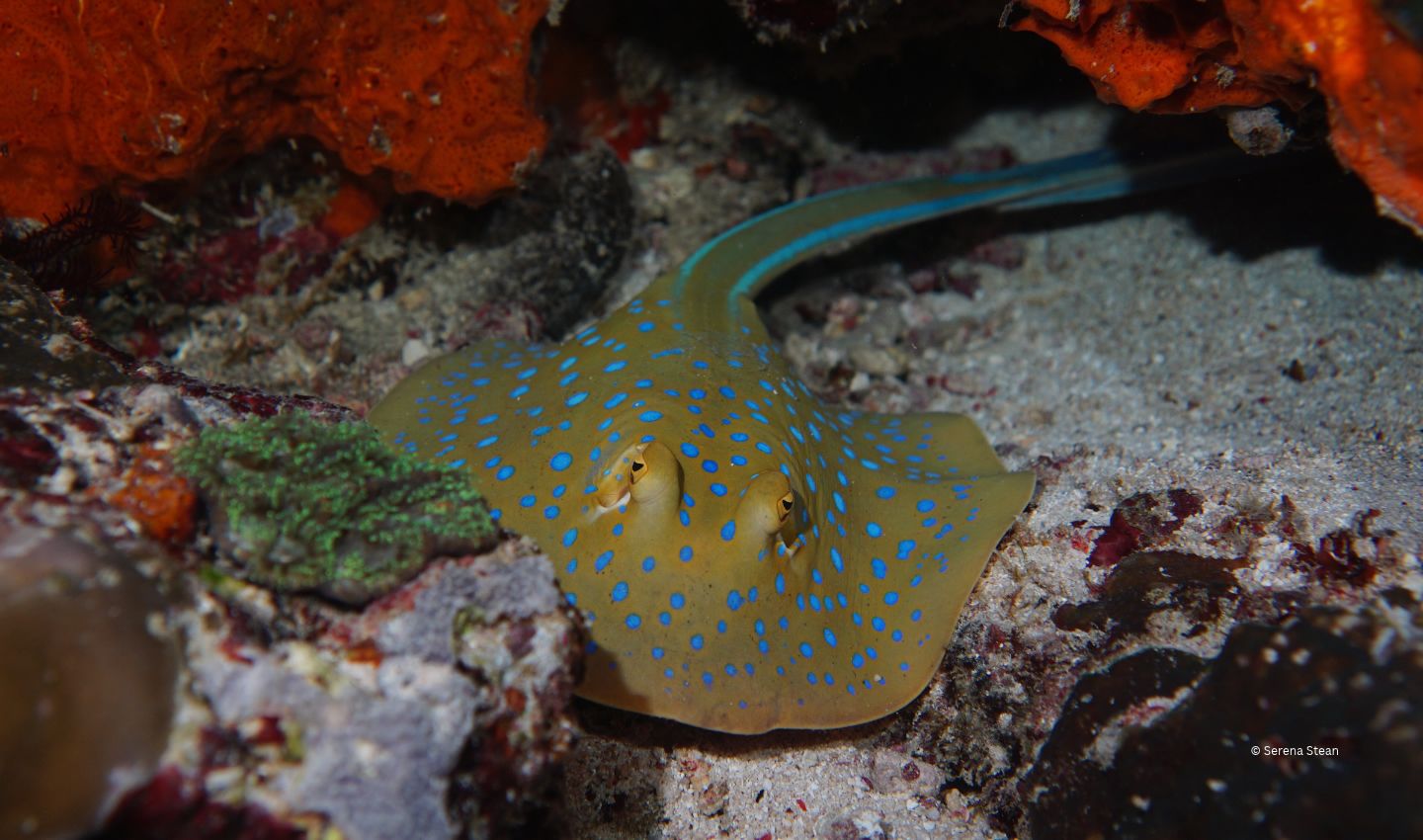
Bluespotted Ribbontail Stingray
Rays and SkatesTaeniura lymma
Detail Information
The venomous vibrant rays
Oval-shaped body
Bluespotted ribbontail rays have a striking appearance, with yellowish-brown to olive-green bodies covered in bright blue spots. They are often confused with the bluespotted stingray (Neotrygon sp.), but they can actually be distinguished by their body shapes.
Bluespotted ribbontail rays have an oval-shaped pectoral disc with broadly rounded outer corners. They have large eyes and large spiracles positioned close together.
Bright blue spots
Another distinctive feature of bluespotted ribbontail rays is the bright blue spots covering the upper surface of their bodies. Unlike colors produced by pigments alone, these spots are created by microscopic structures in their skin that scatter blue light, a phenomenon known as structural coloration. Scientists suggest that these vivid markings may play a role in communication or serve as a warning signal to potential predators. It alerts their predators that they are venomous!
Venomous stings
Bluespotted ribbontail rays are generally shy around humans and tend to swim away when approached by divers. However, they can use their venomous tail spine to defend themselves if threatened!
Bluespotted ribbontail rays have a relatively thick tail that tapers towards its tip. Their tail is less than twice the length of their body disc and usually has one venomous spine located towards the end. This spine, commonly called a sting or barb, is used for defence when they feel threatened.
Scientific Classification
- Kingdom
- Animalia
- Phylum
- Chordata
- Class
- Chondrichthyes
- Subclass
- Elasmobranchii
- Order
- Myliobatiformes
- Family
- Dasyatidae
- Species
- Taeniura lymma